20 Online Business Ideas You Can Start Today
The best online business ideas are the ones you can get moving with the skills, cash and time you already have. So you need to weigh up how fast you can make the first sale, what it’ll cost to set up, and how easily the idea can grow later. You also want a model that fits the UK digital market, especially if you’d rather keep the paperwork tidy from day one.
Key takeaways
- The best ideas are the ones you can test quickly without heavy upfront costs.
- Service-based models are usually the fastest route to your first sale.
- Digital products and subscriptions can scale better, but they take longer to prove.
- A clear one-sentence offer is a strong sign that the idea is ready to validate.
- Sort the legal and tax basics early if you plan to trade regularly in the UK.
What Makes an Online Business Idea Worth Starting
A realistic online business idea needs four things: startup costs that stay low enough, a short route to first income, skills you can use now, and room to scale if it works. That’s the same pattern you see in current idea round-ups from Whop, Mailchimp, GoDaddy, Amazon’s Sell on Amazon guidance and IdeaProof: the strongest ideas are usually easy to explain, quick to test, and simple to improve without having to rebuild everything GoDaddy.
Quick-start ideas are usually service-led or marketplace-led. A freelance copywriting offer, clipping service, affiliate site or email marketing setup can be sold with little more than a laptop and a clear pitch. Slower-build models, like a micro-SaaS product or a course platform, may scale better later, but they usually need more planning, more testing and more patience before any meaningful income shows up IdeaProof.
A useful filter is simple: can you explain the offer in one sentence, and can a stranger see why they’d pay for it? If the answer is yes, you’re probably close to a testable idea. If it’s no, the offer is still too broad.
For UK-facing businesses, don’t skip the basics. If trading becomes regular, you may need to register with HM Revenue & Customs (HMRC), keep records of income and expenses, and stay on top of consumer protection and data privacy obligations, including UK GDPR. Deal with that early, not after you’ve had your first busy month.
20 Online Business Ideas You Can Start Today
- Services: 1. Freelance copywriting – write landing pages, emails or ads for businesses that need words that sell.
- Services: 2. Email marketing setup – build welcome sequences and campaigns for small firms using Mailchimp.
- Services: 3. Affiliate marketing – recommend products on a blog, newsletter or social channel and earn commission on sales.
- Services: 4. Online coaching – sell structured sessions in a niche you know well, from fitness to career support.
- Services: 5. Freelance design – create social graphics, logos or brand kits using Canva and client briefings.
- Services: 6. Virtual assistant work – handle inbox, calendar and simple admin tasks for busy founders.
- Services: 7. Clipping service – turn long videos into short-form clips for creators and brands that post often.
- Digital products: 8. Sell digital templates – make planners, spreadsheets, CV packs or Notion-style systems once and sell repeatedly.
- Digital products: 9. Create online courses – package a practical skill into lessons, worksheets and a simple checkout flow.
- Digital products: 10. Write and sell ebooks – publish short, useful guides on a narrow problem your audience cares about.
- Digital products: 11. Prompt packs and workflow kits – bundle useful AI prompts, checklists or reusable systems for a specific job.
- Digital products: 12. Membership community – charge a monthly fee for access, resources and discussion around a clear niche.
- E-commerce: 13. Dropshipping – sell products through a storefront without holding stock, then let suppliers fulfil orders.
- E-commerce: 14. Print-on-demand – sell T-shirts, mugs or posters with custom designs and no upfront inventory.
- E-commerce: 15. Sell on Amazon – list physical products on Amazon and use the marketplace’s built-in traffic.
- E-commerce: 16. Etsy shop – sell handmade, vintage or digital goods to buyers already browsing for niche items.
- E-commerce: 17. Own-brand Shopify store – build a dedicated store for one product line or a small catalogue.
- Content and audience: 18. Niche newsletter – publish valuable updates in a specialist area and monetise with sponsors, products or services.
- Content and audience: 19. Social media management – plan posts, schedules and engagement for local businesses that need consistency.
- Software and tools: 20. Micro-SaaS – build a small subscription tool that solves one repeat problem for a very specific audience.
Best Online Business Ideas by Skill, Budget and Time
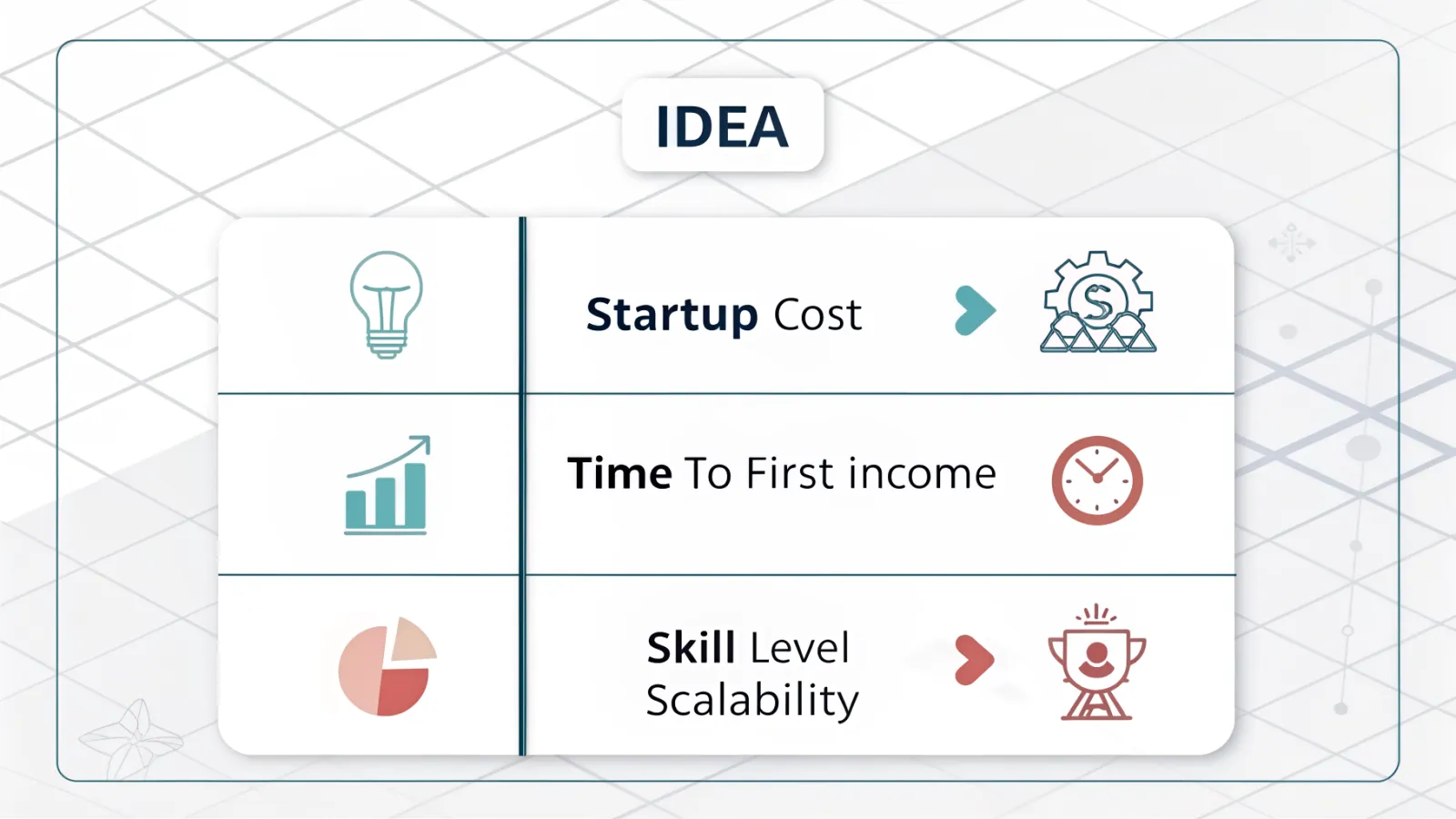
| Idea | Startup cost | Time to first income | Skill level | Scalability |
|---|---|---|---|---|
| Freelance copywriting | Low | Fast | Medium | Medium |
| Email marketing setup | Low | Fast | Medium | Medium |
| Affiliate marketing | Low | Slow to medium | Medium | High |
| Online coaching | Low | Fast | High in a niche | Medium |
| Freelance design | Low to medium | Fast | Medium | Medium |
| Clipping service | Low | Fast | Low to medium | Medium |
| Digital templates | Low | Medium | Medium | High |
| Online course | Low to medium | Slow | High in a niche | High |
| Dropshipping | Medium | Medium | Medium | Medium |
| Print-on-demand | Low to medium | Medium | Medium | Medium |
| Sell on Amazon | Medium | Medium | Medium | High |
| Etsy shop | Low to medium | Medium | Medium | Medium |
| Shopify store | Medium | Medium | Medium to high | High |
| Niche newsletter | Low | Slow to medium | Medium | High |
| Social media management | Low | Fast | Medium | Medium |
| Micro-SaaS | Medium to high | Slow | High | Very high |
Beginners usually do best with services and simple digital products because they can start earning before they’ve built a large audience. That makes copywriting, clipping, design, virtual assistance and social media management practical first bets. If you want stronger long-term margins and can afford to wait, digital products, newsletters and Micro-SaaS offer more upside.
Platform-based ideas sit somewhere in the middle. Selling on Amazon, Etsy or via Shopify can work well, but each one brings more setup work and more dependence on traffic, listings and platform rules. These models suit people who can handle product research, presentation and repeat optimisation.
How to Validate Your Idea Before You Build Too Much
- Check demand first. Search the idea on Google, scan competitor offers, and look at marketplace activity on Amazon, Etsy or creator platforms to see whether people are already paying.
- Narrow the offer. Choose one customer type and one outcome, such as 'email welcome sequence for local service businesses' or 'CV template pack for graduates'.
- Build the smallest usable version. Use Canva for the asset, Google Workspace for communication, and a simple website builder such as GoDaddy or Shopify to publish a landing page and payment link.
- Launch a basic test. Share the offer in relevant communities, send direct messages, or publish a simple post that explains the problem and the result.
- Measure response quickly. Track clicks, replies, saved posts, sample downloads or calls booked, then decide whether to improve the offer, pivot to a better angle, or stop.
The point of validation isn’t to look busy. It’s to find out whether strangers care enough to click, reply or pay. That can happen with one clear page and one good offer; you don’t need a full brand system before you have proof.
Common Mistakes to Avoid When Starting Online
- Do not pick an idea just because it is trending on social media; the trend may be noisy while demand is weak.
- Do not spend weeks building a full product catalogue, course library or app before someone has bought the first version.
- Do not rely entirely on one platform for discovery or sales, because algorithm changes and account issues can cut off traffic overnight.
- Do not ignore UK compliance basics: consumer rights, data privacy under UK GDPR, and records that help you complete tax obligations accurately with HMRC.
One more trap is hiding behind research. Reading about business ideas feels productive, but it can turn into procrastination in a smart-looking coat. Set a deadline, pick one model, and get the first version out in public.
If you want the quickest route, choose a service or a narrow digital product and launch a simple test this week. If you want bigger long-term value, go for something that compounds, such as a newsletter, a course or a specialised tool, then accept that the first sale may take longer but the ceiling is higher.
Frequently asked questions
What is the easiest online business to start?
Service-based ideas are usually the easiest place to begin, especially copywriting, freelance design and virtual assistance. They need very little upfront spend, and you can often land a first client with just a laptop, a clear offer and a simple pitch.
Which online business ideas make money the quickest?
Affiliate marketing, freelancing and a simple digital product tend to bring in money faster than software or content-heavy models. They can be tested quickly because you can explain the offer in one sentence and start selling before you’ve built a large audience.
Do I need a company to start an online business in the UK?
Not always. Many people begin as sole traders and register with HMRC once trading becomes regular. If you start taking sales seriously, keep records from day one and stay on top of UK GDPR and consumer protection rules as well.
How much money do I need to start an online business?
It depends on the model. Some ideas need little more than a laptop and internet access, while e-commerce, selling on Amazon or building software usually involves more setup costs, testing and a bigger cash buffer before you see meaningful income.
Are online business ideas still worth it in 2026?
Yes, provided you choose a specific model and test demand early. The strongest ideas in the article are the ones that are easy to explain, quick to validate and simple to improve without rebuilding everything from scratch.