
Passive Income Ideas for Beginners
Passive income sounds appealing because it suggests money coming in without your full attention every day, but the better beginner options still need setup, capital or a useful skill. The practical move is to separate genuinely low-maintenance income from polished claims that hide work, fees or risk. In the UK, that also means checking the tax treatment early so 'easy money' does not turn into an admin headache.
Key takeaways
- Passive income usually needs upfront time, money or skill before it becomes low-maintenance.
- For beginners, savings interest is the simplest route, while ETFs and dividend shares suit longer-term goals.
- Rental property and digital products can work, but both need more setup and upkeep than many expect.
- UK beginners should check tax, fees and record-keeping early to avoid problems later.
- A small 90-day plan is more useful than chasing quick returns.
What Passive Income actually means
Passive income is money earned with little to no labour after the initial setup, which is why rental income, royalties and some investment returns are often grouped under the same label. Wikipedia notes that the term usually refers to income that needs little upkeep, and it also points out that such income is typically taxable. That distinction matters, because 'passive' is often stretched to cover side hustles that are still very active.
In practice, there are three useful buckets. Truly passive income is the closest thing to set-and-forget, such as interest from savings or dividends from shares held long term.
Semi-passive income still needs some management, like a rental property or a digital product that needs updates, while portfolio income comes from assets such as ETFs and shares that may pay dividends or rise in value without daily effort.
Investopedia is careful on this point, saying that returns from securities are technically portfolio income rather than purely passive income.
That means most passive income ideas need one or more of four things: cash, time, skill or maintenance. New York Life says your existing skills can be a strong starting point, but it also makes clear that many investment routes require capital. If you are buying an income stream rather than building it from scratch, you still have to factor in fees, platform rules and the chance that returns come through slowly.
The realistic expectation is dull, but useful: passive income is usually a long-term strategy, not quick cash. Coursera describes it as something that can take time to grow, which is exactly why beginners should think in months and years rather than weekends. In the UK, that planning step should also include record-keeping from day one, because tax on dividends, interest, royalties and property income can apply depending on the structure you choose.
Beginner-friendly Passive Income ideas compared
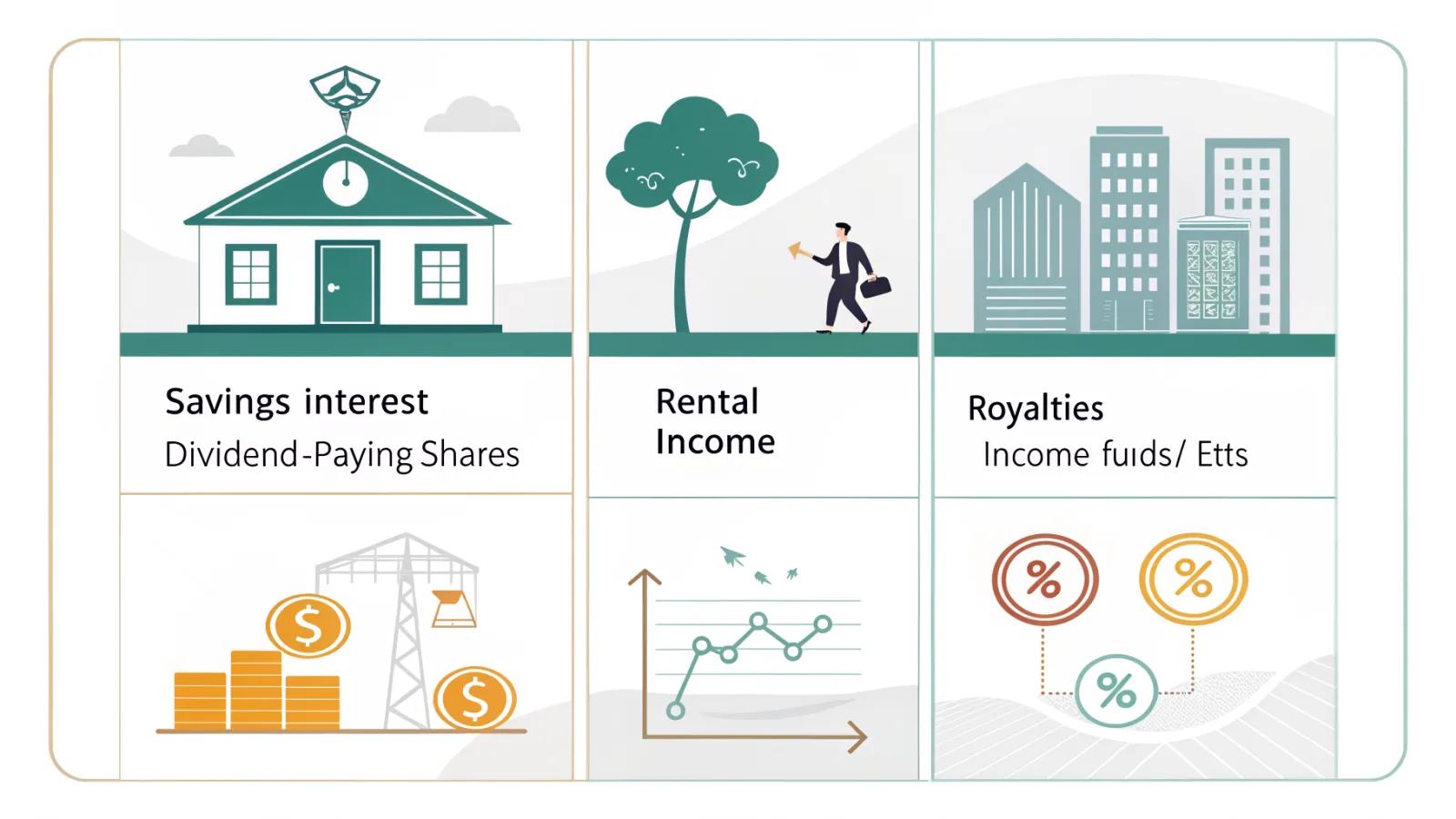
| Idea | Typical starting cost | Ongoing effort | Risk level | Time to first return | Best for |
|---|---|---|---|---|---|
| Savings interest | Low; can start with existing cash | Very low | Low | Immediate or near-immediate | Small budgets and emergency funds |
| Dividend-paying shares | Low to medium | Low to medium | Medium | Weeks to months | People comfortable with market ups and downs |
| ETFs | Low to medium | Low | Medium | Weeks to months | Beginners who want diversification |
| REITs | Low to medium | Low | Medium | Weeks to months | Those who want property exposure without direct management |
| Rental income | High | Medium to high | Medium to high | Months | People with significant capital and tolerance for repairs, voids and regulation |
| Digital products | Low | Medium at setup, low later | Low to medium | Weeks to months | People with a useful skill or niche |
| Royalties | Low to medium | Low after creation | Medium | Variable | Creatives with content, music or written work |
For sheer ease, savings interest is the simplest starting point if you already have cash sitting idle. The important UK questions are whether the money is held with an FSCS-protected provider, whether the rate is from an easy-access savings account or a current account, and whether any interest above your Personal Savings Allowance will be taxable. Simple does not usually mean high return, but it does mean easy to understand.
Dividend-paying shares and ETFs are a better fit if you want your money to work harder over time. Western & Southern Financial Group explains that stocks, bonds and ETFs can generate income through dividends, interest and potential capital gains, while property exposure can also come through REITs without direct management. For South African readers comparing options, that is the main attraction: you can get broad exposure without becoming a landlord.
Rental income can look attractive on paper, but it is rarely beginner-friendly unless you already own property and have strong margins. It is exposed to vacancies, repairs, tenant issues and local rules, so the 'passive' label is generous. Digital products and royalties sit in a different category: once they are built, they can be low-maintenance, but the work is front-loaded because you have to create something people actually want to buy or use.
How to choose the right income stream for your situation
- Decide whether your main goal is cash flow, long-term growth or diversification. A savings account or income fund suits cash flow, while ETFs and dividend shares are usually better for longer-term compounding.
- Assess what you already have: spare cash, a marketable skill, a digital asset or property. New York Life is right that skills matter, because they can become the raw material for a product, course, template or licenceable asset.
- Choose one low-maintenance income stream that fits your risk tolerance and the time you can realistically give it. If you are nervous about price swings, start with interest or a simple savings product before moving into markets or property.
- Set a simple 90-day target so the idea becomes a project instead of a vague plan. For example, open the account, set the monthly contribution and automate the first transfer, then review whether the setup still fits your budget and goals.
What UK beginners usually get wrong
- Expecting immediate returns from every idea, especially those that need setup time. A digital product, ETF portfolio or rental arrangement may take months before it feels worthwhile.
- Ignoring tax treatment and record-keeping from day one. Interest, dividends, royalties and rental income can all have reporting consequences, so a simple spreadsheet is better than a memory-based system.
- Underestimating start-up effort, particularly for digital products, investments and rental income. Even a low-maintenance asset needs a plan, a platform and occasional review.
- Putting money into high-risk offers that sell the idea of effortless income without explaining the downside. If the pitch sounds like guaranteed freedom, treat it as a warning sign.
One useful check is to ask who is actually doing the work. If the answer is 'you, every week', that is not really passive income. If the answer is 'the asset does most of the work, but I still monitor it', you are probably looking at a more realistic beginner option.
A realistic first-month plan to get started
- Pick one low-complexity option and one longer-term option so you are building momentum and optionality. A savings account or basic dividend strategy can sit alongside a digital product idea or course outline.
- List the minimum capital, tools and time required before you start. Coursera’s point about slow build-up is useful here: if you cannot afford the setup, you need a smaller version of the plan.
- Create the asset, account or system and launch it in a basic, functional form. For investments, that might mean opening the right account; for a digital product, it might mean publishing version one rather than waiting for perfection.
- Review results monthly and improve one part at a time rather than trying to build everything at once. Track what is actually working, then increase the contribution, improve the listing or refine the product only after you have data.
The best beginner choice is usually the one you can stick with long enough to learn from it. If you start small, keep the admin tidy and avoid hype, passive income becomes a steady build rather than a speculative gamble. That is the difference between a useful income stream and an expensive distraction.
Frequently asked questions
What is Passive Income in simple terms?
Money that keeps coming in after the main work has been done, with only limited ongoing effort. In practice, it usually means some work or capital went in first, then the income continues with far less day-to-day involvement. The article groups examples like savings interest, dividends, rental income and royalties under that wider label.
Is Passive Income really passive?
Usually not fully. Most streams need setup, monitoring or occasional maintenance, and some need all three. The article distinguishes truly passive income, such as savings interest, from semi-passive ideas like rentals or digital products that still need updates or management.
What is the easiest Passive Income idea for beginners?
Low-effort options such as interest-bearing savings, dividend income or a simple digital product are usually the easiest starting points. For pure simplicity, the article says savings interest is the clearest route, especially if you already have cash sitting idle and want something easy to understand before moving into investments.
Do you need a lot of money to start Passive Income?
No. Some ideas need capital, but others rely more on time or a skill than large upfront cash. The article makes that trade-off clear: savings and some investment routes depend on spare cash, while digital products or licenceable assets can lean more on your existing skills and effort.
Is Passive Income taxed?
Yes, in most cases it is taxable, so records matter from the start. In the UK, that can apply to dividends, interest, royalties and property income depending on the structure you choose, which is why the article recommends keeping proper records from day one.